Keno Strategy: How Many Numbers to Pick
Most keno advice online is about picking the right numbers. Hot numbers, cold numbers, birthdays,...
Most keno advice online is about picking the right numbers. Hot numbers, cold numbers, birthdays, patterns on the board. None of it matters. In a fair draw every number has the same chance, every single round.
What does matter is how many numbers you pick and which risk level you play. Those two settings decide how often you get paid and how big the hits are. This guide is about getting those two right on Duel Keno, where the math is finally on your side.
Keno at Duel in 30 seconds
The board has 40 numbers. You pick between 1 and 10 of them, 10 numbers get drawn, and you're paid by how many of yours hit. You choose one of four risk levels: Classic, Low, Medium or High. The top payout is 1,200x.
Keno is a Duel Original. The raw paytable returns 99.9% on every combination of picks and risk level, and Duel pays the last 0.1% back as instant rakeback. That puts your return at 100% RTP on bets up to $1,000, inside the zero edge limit of $50,000 wagered per 24 hours.
Compare that with live keno in Las Vegas, which returns 65% to 80% according to the Wizard of Odds. Same game idea. A completely different price.
The one formula worth knowing
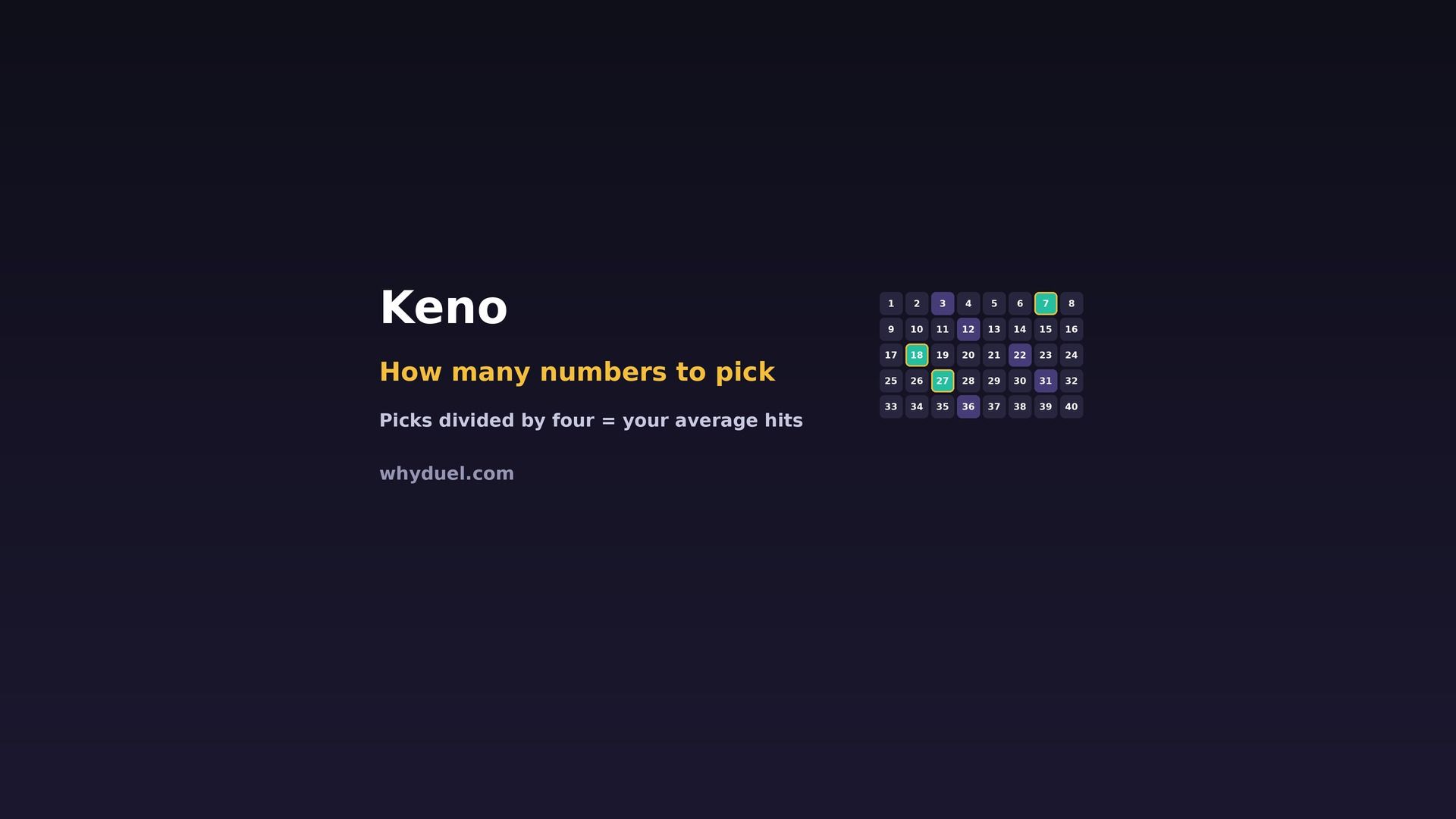
Here's the number nobody puts on the screen. Your average number of hits is your picks divided by four.
Why four? Because 10 of the 40 numbers are drawn, so each number you pick has a 25% chance to hit. Pick 4 numbers and you average one hit. Pick 8 and you average two. Pick 10 and you average two and a half.
That one fact explains why the paytable looks the way it does. With 10 picks, hitting 2 or 3 is a normal round. Hitting 7 or more is a rare event. The game pays small for the normal stuff and huge for the rare stuff.
What each pick count actually feels like
These are plain combinatorics for a 40 number board with 10 drawn. They're the same on every risk level, because risk only changes what a hit pays, not how often it happens.
1 pick
25% to hit, 75% to miss. On Classic a hit pays about 4x. This is the closest keno gets to a coin flip with a bigger payout. Fast results, short swings.
3 picks
41% of rounds you hit nothing. 44% you hit one, about 14% you hit two, and about 1.2% you hit all three. A small step up in drama without getting silly.
5 picks
About 22% of rounds have no hits at all. The most common result is one hit at around 42%. All five lands about 4 times in 10,000 rounds.
10 picks
Only about 3.5% of rounds have zero hits, but the middle is where you live. Two hits happen about 31% of the time and three hits about 29%. All ten is 1 in 847,660,528. That's the 1,200x spot on Low, Medium and High.
So the question isn't "how many picks win most". It's "how much waiting can I handle between real hits".
Risk level is a volume knob
Classic, Low, Medium and High don't change your return. Every setup sits on the same 99.9% raw paytable plus the 0.1% rakeback. What changes is where the money sits.
On Low with 10 picks, about 80% of rounds pay something back. Lots of small returns, slow balance movement, long sessions.
On High with 10 picks, about 80% of rounds pay nothing. Your balance drops in a quiet line and then jumps when a big hit lands. Same expected return. Very different nerves.
Classic is its own shape and caps out at 200x instead of 1,200x. Check the paytable under the board for the exact numbers on your setup.
The real rule is simple. Pick the risk level your bankroll can sit through, not the one with the biggest number on the board. If High with 10 picks takes your session budget out in twenty rounds, that isn't bad luck. That's exactly what High is built to do.
Three keno habits that cost players money
Keno at 100% RTP doesn't charge you for bad habits through the paytable. You pay for them through your bankroll.
Chasing with more picks
You lost a few rounds, so you jump from 4 picks to 10 and from Low to High. It feels like you're playing for the comeback. You're actually making the next empty round more likely. Variance goes up, the return stays the same.
Playing hot and cold numbers
A number that hit three rounds in a row has exactly the same chance as every other number on the next draw. Autopick is as good as a board you studied for ten minutes. Duel's draw is fixed by your server seed, client seed and nonce before you bet, so there's nothing for a pattern to catch.
Betting for the screenshot
1,200x is real, but it's a 1 in 847 million event. Most of the return in keno comes from the hits that actually land, like 4 or 5 out of 10. Play for those and treat a monster hit as a bonus.
Three setups for three kinds of player
There's no best setup, only the right one for the session you want.
- The grinder. 1 to 3 picks on Classic or Low. Frequent results, small swings, ideal for long sessions inside the daily limit.
- The middle road. 5 to 8 picks on Medium. Enough dry rounds to keep it interesting and enough hits to keep you in the game.
- The lottery ticket. 10 picks on High with a small bet. Most rounds pay nothing, and you size the bet so that's fine.
Whatever you choose, set a session budget and a profit target before you start, and leave when you hit either one.
Where the limit kicks in
The 100% RTP holds for bets up to $1,000 and wagers up to $50,000 per 24 hours. Above that a scaling edge starts at 0.1% and rises with bet size, and Duel shows it in the game before you play. For Keno it's based on your maximum potential win, so a 10 pick High bet reaches it sooner than a 1 pick Classic bet. The current figures live in Duel's economics changelog.
The vast majority of players never get near that limit, so in practice they never pay a house edge on Keno. If you want to see what that means against other casinos, our guide on what house edge really is breaks it down, and the house edge guide compares game by game.
Check the draw yourself
Every draw can be replayed. Rotate your seed pair, Duel reveals the server seed, and you can verify any round in the Verify tab or with the free verifier at ProvablyFair.org. ProvablyFair.org replayed 5,100 live Keno draws across all 40 combinations of picks and risk levels and every draw and payout matched. Our trust page explains what the certificate covers.
If you like choosing your own variance, Plinko works the same way with rows and risk levels instead of picks.
FAQ
How many numbers should I pick in keno?+
It depends on how much variance you want. Every pick count has the same return at Duel. Fewer picks means more frequent, smaller results. Ten picks means long dry spells and a shot at 1,200x.
Does the risk level change my odds?+
No. It changes what each hit count pays, not how often hits happen. Low pays small amounts often, High pays rarely but bigger.
Do some numbers come up more often?+
No. Every number on the 40 number board has the same chance every round, and the draw is fixed by your seeds before you bet.
Pick your numbers
Ready to try a setup? Sign up through our Join Duel page and enter the code WHYDUEL when you register. Start small, pick a risk level your bankroll can sit through and see what fair keno feels like.
Written by WhyDuel Team
The WhyDuel Team analyzes Duel Casino games, fairness systems, and strategies to help players understand how Duel works.